

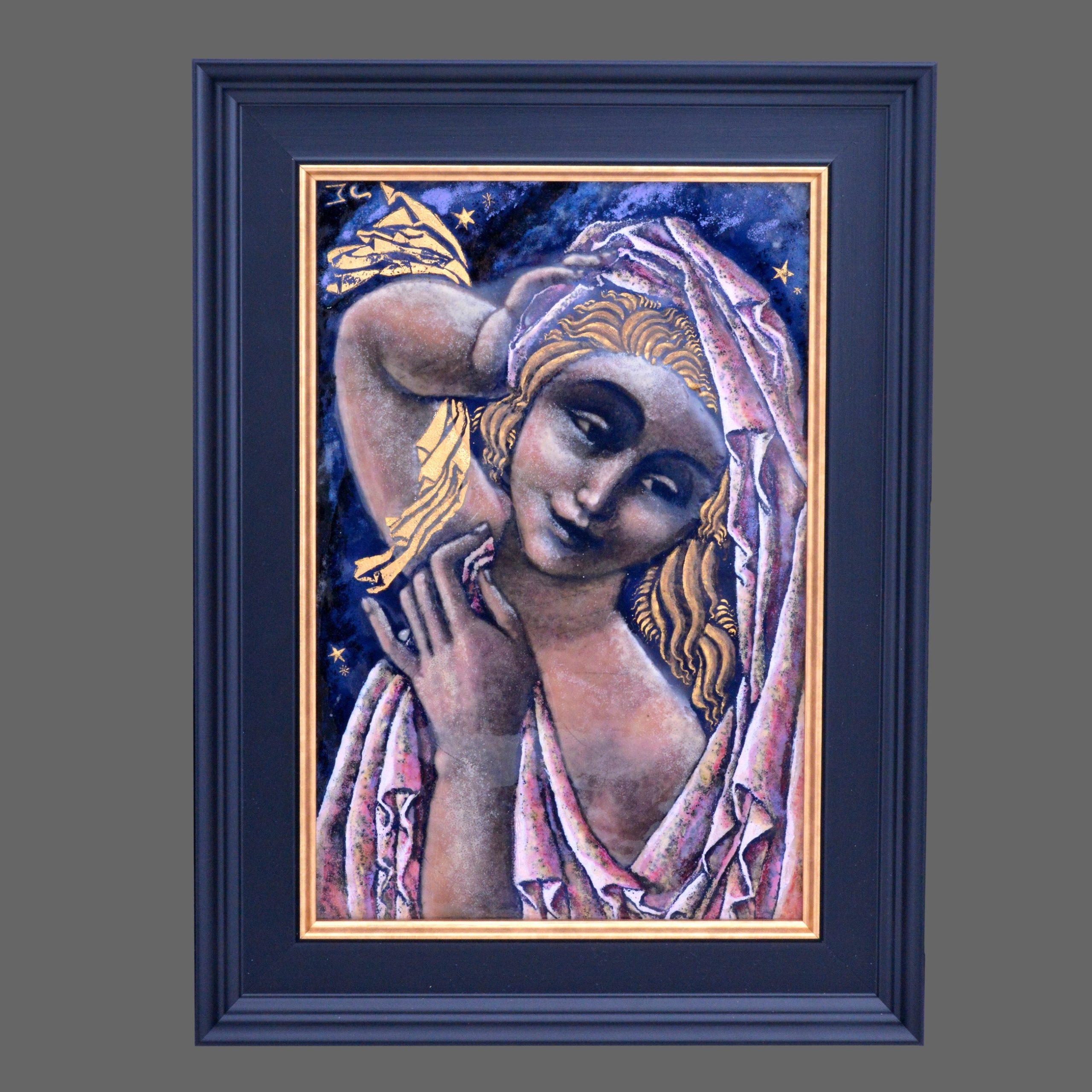
A Maria Schwammberger large enamel Secessionist plaque
For sale is this large Austrian Secessionist plaque by Maria Schwamberger-Riemer (c.1896–1970) – Austrian enamel artist. Her biography is below. The plaque depicts a woman with wistful expression holding a cape to cover herslef against a night sky. It is signed with Maria Schwammberger’s SM monogramme. The plaque likely dates to c 1925 and also shows the design influence of the art deco movement in the stylization of the woman depicted. The frame is modern. for other examples of her work see this link.
Biogaraphy
Maria Schwamberger-Riemer (often spelled “Schwammberger”) was born in Vienna in 1896 . She received formal art education at Vienna’s Graphische Lehr- und Versuchsanstalt from 1915 to 1916, and then continued her studies at the Kunstgewerbeschule (School of Applied Arts) . At the Kunstgewerbeschule she trained under prominent figures of Viennese art and design – Franz Cižek in the ornamental design class, Berthold Löffler in the painting class, and in the enameling workshop led by Adele von Stark and architect Josef Hoffmann.
Schwamberger-Riemer developed a specialty in Emailmalerei, or enamel painting on metal, which became the focus of her career. Active during the Wiener Werkstätte and late Jugendstil era, she embraced the symbolist and decorative potential of enameling. Critics noted her ability to combine meticulous technical precision with artistic sensitivity, producing works of exceptional color brilliance and refinement . Many of her pieces center on intimate portrayals of women, mythological subjects, and allegories, reflecting a distinctly feminine perspective and elegant stylization.
Maria was associated with the Wiener Frauenkunst (Viennese Women’s Art) group, a society of female fine and applied artists founded in 1926 . The Wiener Frauenkunst aimed to improve professional and economic opportunities for women artists and promoted a modern, life-oriented and feminist aesthetic . Schwamberger-Riemer’s documented artworks span allegorical imagery, portraits, and decorative motifs, executed mostly as enamel panels. She typically signed her pieces with a conjoined monogram “SM” (for Schwamberger Maria), usually formed in brass wire and fused into the enamel . This “SM” monogram appears on her known works from the 1920s–1940s.
Several of Schwamberger-Riemer’s works have been preserved in museums and archives. The Belvedere Museum in Vienna holds her Doppelbildnis (“Double Portrait”, c.1930), an enamel painting on copper ~21 × 18.5 cm . This piece, a double female portrait in luminous colors, is representative of her mature style and is now part of Austria’s national art collection .
After World War II, Schwamberger-Riemer continued to apply her enamel artistry in Austria, increasingly in architectural and public art projects. She contributed to postwar decoration programs of Vienna’s municipal housing. For example, in the early 1950s she created enamel house plaques and mosaics for the large Jedlesee housing estate (21st district, Floridsdorf). Her works at Jedleseer Straße 79–95 (completed 1955) include a series of animal-themed enamel panels mounted at different stairway entrances – specifically motifs of a frog, crayfish, carp, pike, and catfish to serve as vivid house symbols . These pieces, often referred to as “Hauszeichen” or house signs, were installed as a kind of artistic wayfinding system and remain visible on the buildings . Photographic documentation shows some of these mid-century works, such as a tile-mosaic Wels (catfish) plaque dated 1955, attributed to her in situ .
In 1961, Schwamberger-Riemer produced a series of bird-themed plaques for another municipal complex at Roggegasse 44–46 (Floridsdorf). These enamel or ceramic panels – depicting a swallow, kingfisher, woodpecker, goldfinch, raven, and owl, among others – were installed above entrances and carry her attribution and the year . An example is the “Wiedehopf” (Hoopoe) house plaque dated 1961, which is documented as her work . Such commissions demonstrate that she remained an active creator of public art well into the 1950s and early 1960s. In the city center, one of her notable works is a commemorative enamel panel on a building at Johannesgasse 9–13 (1st district). This panel, titled “Die armen Studenten” (“The Poor Students”), was designed by Schwamberger-Riemer to honor the historical student almshouse (Burse) that once stood at that site . Installed on the facade of what is now known as the Goldberg’sche Stiftungshaus, the enamel shows impoverished students – a nod to the building’s past – and serves as both an artwork and a historical marker. It is one of several examples where her work intersects with Vienna’s cultural memory on building surfaces.
Maria Schwamberger-Riemer passed away in 1970 in Mödling, a town just south of Vienna, at the age of 74 .
Price: £1,450
Maker: Maria Schwammberger
Designer: Maria Schwammberger
Date : c. 1925
Marks: Signed with monogramme
Material: Enamel on copper
Condition: Excellent. Modern frame
Size: Plaque: 28.0 cm x 18.5 cm
Weight : NM
Additional Information
| Price range | £1,000 – 5,000 |
|---|---|
| Period | Arts and crafts, Other |
| Material | Enamel |